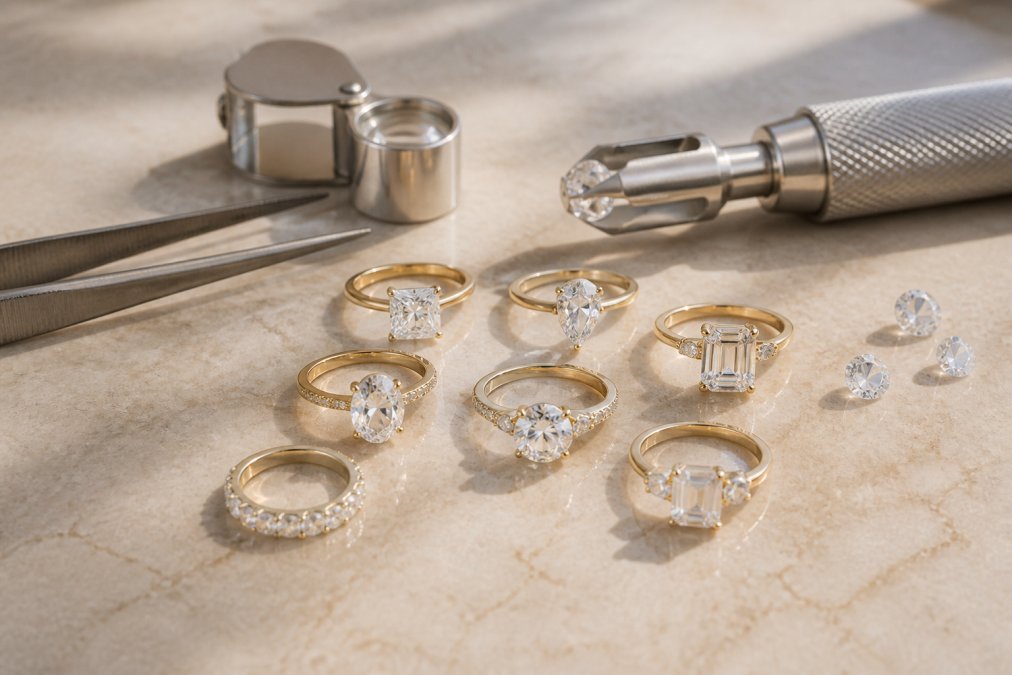
 listicle
Buy Lab Grown Diamond Ring: 7 Stunning IGI Certified Picks
Table of Contents
- Why Buy a Lab Grown Diamond Ring Over a Natural Stone?
- What to Look for in IGI Certified Lab Grown Diamonds
- How to Choose a Diamond Engagement Ring: The 4Cs, Simplified
- Our Top Lab Grown Diamond Ring Picks for Every Style
- Lab Grown Diamond vs Natural Diamond: Price and Value Compared
- Physical vs. Chemical Verification: How to Confirm What You Buy
- Resale Value Realities and Metal Type Durability
- Conclusion: Find Your Forever Ring
- Frequently Asked Questions
Last Updated: September 6, 2026
Why Buy a Lab Grown Diamond Ring Over a Natural Stone?
A lab grown diamond ring offers the identical fire, brilliance, and durability of a mined stone at a fraction of the cost. When you buy lab grown diamond ring options from Native Jewel, you are selecting a diamond that is chemically, physically, and optically identical to its natural counterpart. The only difference is the origin: one is formed over billions of years beneath the earth's crust, the other is cultivated in weeks using advanced technology that replicates those exact conditions.
Because the supply chain is shorter and direct-to-consumer models eliminate traditional retail markups, you can afford a larger carat weight or a higher color grade for the same budget. This guide walks you through our IGI certified picks, explains the 4Cs in plain language, and settles the lab grown vs. natural debate.
What to Look for in IGI Certified Lab Grown Diamonds
IGI certification is your guarantee that the diamond has been independently assessed by a reputable gemological laboratory. The International Gemological Institute (IGI) is one of the world's most respected authorities, and its report confirms the stone's carat weight, color grade, clarity, and cut quality. Never purchase a stone without it.
When reviewing a certificate, pay close attention to the cut grade first. An "Excellent" cut reflects light with maximum brilliance, while a poorer cut will appear dull despite a high color grade. All Native Jewel diamonds are graded D Colorless, VS1 Clarity, and Excellent Cut, ensuring a completely colorless stone with inclusions difficult to see even under 10x magnification, cut to maximize sparkle.
How to Choose a Diamond Engagement Ring: The 4Cs, Simplified
Choosing a diamond engagement ring comes down to balancing the 4Cs: carat, color, clarity, and cut. While all four matter, understanding how they interact is key to getting the best visual result for your budget. Here is a practical guide to each C, with the trade-offs you need to know.
Cut: The Engine of Brilliance
Cut is the only one of the 4Cs entirely within human control and has the greatest impact on a diamond's beauty. A well-executed cut allows light to enter the stone and return to your eye as brilliance and fire; a poorly proportioned cut, even on a flawless stone, will appear dull.
Look for a cut grade of "Excellent" or "Ideal." A common mistake is prioritizing carat weight over cut, but a well-cut 1.5-carat stone will always outshine a poorly cut 2-carat stone.
Color: The Subtlety of White
The GIA color scale runs from D (completely colorless) to Z (light yellow or brown). Differences between adjacent grades are often invisible to the untrained eye once set, but the price differences can be substantial.
- D-F (Colorless): The rarest and most expensive. These stones show no color even under magnification.
- G-J (Near-Colorless): These stones appear colorless to most people, but a trained gemologist can detect a slight warmth. They offer exceptional value, as the savings can be put toward a larger carat weight or a better cut.
- K-M (Faint Color): A slight yellow tint becomes noticeable, particularly in larger stones. This can be masked by a yellow gold setting, but it is generally not recommended for white gold or platinum.
A practical tip: if you are choosing a yellow gold setting, you can safely drop to a G or H color grade without any visible difference, saving a significant amount of money. The warm metal will mask any faint tint.

Clarity: The Art of Invisibility
Clarity grades measure the presence of internal inclusions (flaws) and external blemishes. The scale ranges from Flawless (no inclusions visible under 10x magnification) to Included (inclusions visible to the naked eye).
For most buyers, the goal is an "eye-clean" stone, meaning no inclusions visible without magnification, typically achieved at VS1 or VS2 grades. The difference between VS1 and VS2 is often a matter of inclusion location, not just size. An SI1 stone can also be eye-clean, offering greater value, but you must examine it carefully or rely on a high-resolution image and a reputable certificate.
Carat: The Matter of Presence
Carat weight is the most personal choice, as it directly affects the ring's visual presence. However, cut proportions and shape also play a significant role in perceived size.
- Round Brilliant: The most popular shape, it is cut to maximize brilliance and appears its full carat weight.
- Oval and Pear: These elongated shapes appear larger than a round of the same carat weight because the surface area is spread over a longer distance. A 2-carat oval can look like a 2.5-carat round.
- Radiant and Princess: These square shapes have a smaller surface area for their weight, making them appear slightly smaller than a round of the same carat weight.
Consider finger size as well: a 2-carat stone on a size 4 finger looks more prominent than on a size 7. When you choose a diamond engagement ring from our collection, you receive a curated balance of all 4Cs.
Our Top Lab Grown Diamond Ring Picks for Every Style
Every ring in the Native Jewel collection is handcrafted in 14K gold and features an IGI certified lab grown diamond center stone. We have selected standout designs that cater to different aesthetics, from maximum brilliance to minimalist elegance.

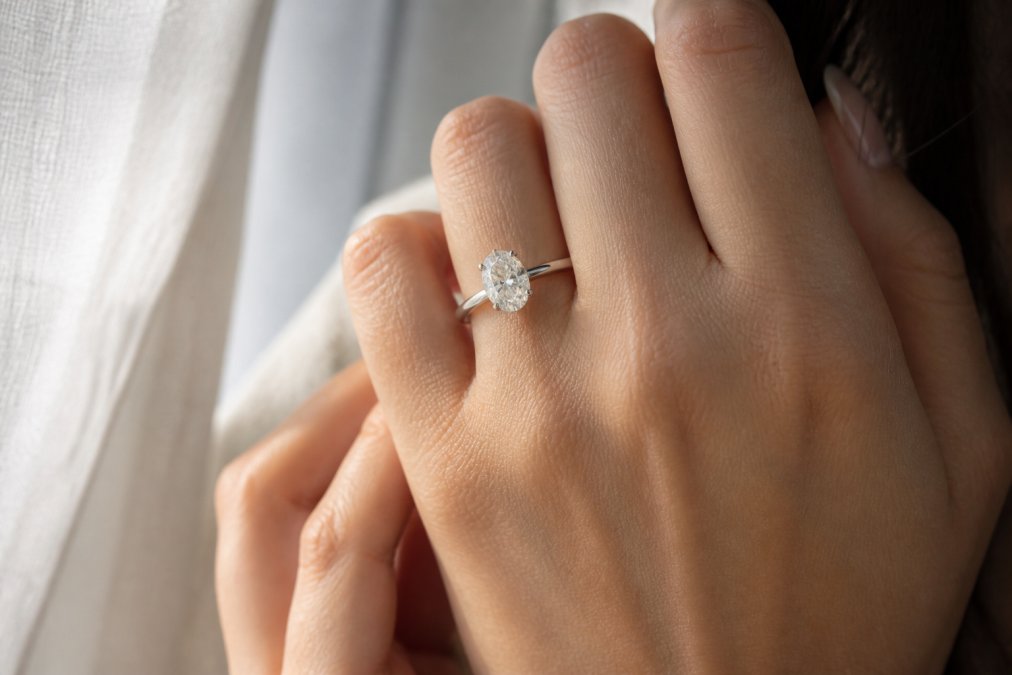
Best for Maximum Brilliance: 3.6ct Oval Cut in 14K White Gold
This 3.6ct Oval Cut Lab Grown Diamond IGI Certified 14K White Gold Engagement Ring is the showstopper of our collection, priced at $2,500.00. The elongated oval shape creates a flattering, slimming effect while the D Colorless, VS1 clarity stone delivers exceptional fire. The 14K white gold prong setting holds the 3-carat center stone securely, while .6 carats of pavé diamonds along the 2mm band add extra brilliance. This is the ring for someone who wants maximum sparkle and a classic silhouette.
Best for a Romantic Vibe: 3.55ct Pear Cut in 14K Yellow Gold
The 3.55ct Total Weight Pear Cut Lab Grown Diamond IGI Certified 14K Yellow Gold Engagement Ring offers a unique, romantic silhouette, priced at $3,500.00. The pear shape combines the brilliance of a round cut with the elegance of a marquise. Set in warm 14K yellow gold with a .5 carat pavé band, this ring feels both vintage-inspired and modern.
Best for Modern Glamour: 5.11 CTTW Radiant Cut in 14K Yellow Gold
For those who want undeniable presence, the 5.11 CTTW Radiant Cut Lab Grown Diamond IGI Certified 14K Yellow Gold Engagement Ring delivers, priced at $4,500.00. The radiant cut's cropped corners and 70 facets create a spectacular, crushed-ice effect that rivals a round brilliant. With a 4.06-carat center stone and 1.05 carats of pavé side stones, this ring offers over 5 carats of total weight for a truly glamorous look.

Best for Minimalist Taste: 2ct Oval Solitaire in 14K Yellow Gold
The 2ct Oval Cut Lab Grown Diamond IGI Certified 14K Yellow Gold Solitaire Engagement Ring proves that sometimes less is more, priced at $2,100.00. This design focuses entirely on the 2-carat oval center stone, held by a classic four-prong setting that allows maximum light to enter. The clean, unadorned 14K yellow gold band lets the stone take center stage.
| Ring Pick | Style | Carat Weight | Price |
|---|---|---|---|
| 3.6ct Oval, White Gold | Maximum Brilliance | 3.6 CTTW | $2,500.00 |
| 3.55ct Pear, Yellow Gold | Romantic | 3.55 CTTW | $3,500.00 |
| 5.11 CTTW Radiant, Yellow Gold | Modern Glamour | 5.11 CTTW | $4,500.00 |
| 2ct Oval Solitaire, Yellow Gold | Minimalist | 2 CTTW | $2,100.00 |
Lab Grown Diamond vs Natural Diamond: Price and Value Compared
The lab grown diamond vs natural diamond debate is settled by one factor: value. Lab grown stones offer the same optical properties, hardness, and beauty as natural diamonds but at a significantly lower price point. This price difference is not a reflection of lower quality; it is simply the result of a more efficient supply chain that bypasses the costs of mining, sorting, and the traditional retail markup. As noted by the Federal Trade Commission's guidance on diamond marketing, lab grown diamonds are real diamonds, not simulants like cubic zirconia.
The Price Gap: What You Actually Save
The price difference scales with carat weight and quality. The larger the stone, the more dramatic the savings.
For example, the 3.6ct oval ring in our collection is priced at $2,500.00.
The Ethical and Environmental Dimension
The value equation extends beyond the sticker price. While the Kimberley Process has reduced the flow of conflict diamonds, it does not address all environmental or labor concerns. Open-pit mining displaces large volumes of earth, and artisanal mining can involve unsafe working conditions.
Lab grown diamonds are created in controlled laboratory environments using two primary methods: High Pressure-High Temperature (HPHT) and Chemical Vapor Deposition (CVD). Both have a significantly lower environmental footprint than mining. For many buyers, this provenance is a key part of the value proposition.
A Direct Comparison Framework
To make an informed decision, consider the following factors side-by-side:
| Factor | Lab Grown Diamond | Natural Diamond |
|---|---|---|
| Chemical Composition | Pure carbon (cubic crystal structure) | Pure carbon (cubic crystal structure) |
| Physical Properties | Mohs hardness of 10, refractive index 2.42 | Mohs hardness of 10, refractive index 2.42 |
| Typical Cost (1ct, D-VS1) | ||
| Typical Cost (2ct, D-VS1) | ||
| Environmental Impact | Controlled lab production, lower energy/water use | Mining, land displacement, higher energy/water use |
| Origin Verification | IGI or GIA certificate with growth origin | Kimberley Process certification, geological origin |
| Resale Market | Limited, emerging | Established, but often below retail |
The Trade-Off: Resale Value
It is important to address the resale value realities of lab grown diamonds honestly. Unlike natural diamonds, which have an established secondary market, lab grown diamonds currently have a limited resale market. This is a trade-off for the significant upfront savings. You should view a lab grown diamond ring as a purchase for its beauty and lifetime enjoyment, not as a financial investment that will appreciate. The money you save upfront is your primary value.
The choice is not about sacrificing quality for cost; it is about making a smart, informed financial decision. For the same budget, a lab grown diamond ring can offer a larger carat weight or a higher color and clarity grade.
Physical vs. Chemical Verification: How to Confirm What You Buy
A question we hear often is how to verify that a lab grown diamond ring is real and not a lookalike. Lab grown diamonds share the exact chemical composition (pure carbon in a cubic crystal structure) and physical properties (a Mohs hardness of 10 and a refractive index of 2.42) as natural diamonds. Simple tests like a scratch test or a thermal conductivity probe cannot distinguish them.
Verification requires advanced testing. IGI certification is the most reliable method for the consumer, involving rigorous testing by trained gemologists using spectroscopy to detect the specific growth patterns of lab created stones. It provides an independent, scientific guarantee of the stone's origin and quality. When you buy from Native Jewel, your ring arrives with its IGI certificate.
Resale Value Realities and Metal Type Durability
It is important to address the resale value realities of lab grown diamonds honestly. Unlike natural diamonds, which have an established secondary market, lab grown diamonds currently have a limited resale market. This is a trade-off for the significant upfront savings. You should view a lab grown diamond ring as a purchase for its beauty and lifetime enjoyment, not as a financial investment that will appreciate. The money you save upfront is your primary value.
Regarding metal durability, our rings are crafted in 14K gold, a choice that balances beauty with practicality. 14K gold is alloyed with harder metals for superior durability in everyday wear. All Native Jewel rings are covered by a lifetime warranty on the diamond and craftsmanship.
Conclusion: Find Your Forever Ring
Choosing the perfect engagement ring is a deeply personal journey, and the balance of beauty, ethics, and budget can feel overwhelming. At Native Jewel, we have curated a collection of IGI certified lab grown diamond rings in 14K gold that resolve this tension, offering heirloom-quality craftsmanship at a direct-to-consumer price. Each piece is handcrafted, ethically sourced, and backed by our lifetime warranty and 30-day hassle-free returns.
Whether you are drawn to the maximum brilliance of an oval cut or the romantic silhouette of a pear, your forever ring is waiting. Get started with Native Jewel and find a lab grown diamond ring that reflects your unique love story.
Frequently Asked Questions
Is it worth buying a lab-grown diamond ring?
Yes, for most couples. A lab grown diamond ring offers the same optical properties, fire, and brilliance as a natural diamond at a significantly lower cost. Since they are chemically identical, the only real difference is origin. You can often afford a larger carat weight or higher color and clarity grades for the same budget, making them a smart choice for those prioritizing value without compromising on quality.
Are lab-grown diamonds considered real diamonds?
Yes. Lab-grown diamonds are real diamonds, not simulants like cubic zirconia. They are composed of pure carbon in the same crystal structure as mined stones. Both CVD and HPHT processes create genuine diamonds. The distinction is origin, not authenticity. A lab grown diamond ring will pass standard diamond testers and exhibit the same hardness (10 on the Mohs scale) and brilliance as a natural stone.
Do lab-grown diamond rings hold their value?
Lab-grown diamonds generally have a lower resale value than natural diamonds, similar to how a new car depreciates once driven off the lot. The market for pre-owned lab-grown stones is still developing. Rather than viewing your ring as an investment, consider its daily value: a larger, higher-quality stone for your budget. The lifetime warranty and craftsmanship of the ring itself provide the lasting value.
How do I verify the quality of a lab-grown diamond?
Look for independent certification from a reputable lab like IGI. This report details the exact carat weight, color grade, clarity grade, and cut quality of your specific stone. At Native Jewel, every lab grown diamond ring includes IGI certification, confirming its specs and origin. You can cross-reference the unique report number on the IGI website to ensure the certificate matches the diamond you receive.