 listicle
Affordable 14k Gold Engagement Rings: 5 Picks
Table of Contents
- Affordable 14k Gold Engagement Rings: A Comparison of Native Jewel's Top Picks
- 1. Oval Solitaire: The Timeless Choice for Maximum Sparkle
- 2. Emerald Cut: A Sophisticated Step Toward Vintage Glamour
- 3. Pear and Marquise Cuts: Elongated Silhouettes for a Unique Look
- 4. Radiant Cut: The Best of Both Brilliance and Fire
- 5. Cushion Cut with Pavé: A Touch of Vintage Romance
- 14k Gold vs 18k Gold Durability: Why 14k Wins for Everyday Wear
- Can You Wear 14k Gold in the Ocean? What You Need to Know
- Frequently Asked Questions
Last Updated: September 8, 2026
Shopping for an engagement ring often feels like a tug-of-war between diamond size and setting cost. The good news is that affordable 14k gold engagement rings make it possible to have both. At Native Jewel, we specialize in handcrafted 14K gold and IGI-certified lab-grown diamond pieces that deliver heirloom quality without traditional retail markups.

Affordable 14k Gold Engagement Rings: A Comparison of Native Jewel's Top Picks
A 14k gold engagement ring is an alloy of 58.3% pure gold mixed with harder metals, giving it the strength for daily wear while retaining the warm luster of gold.
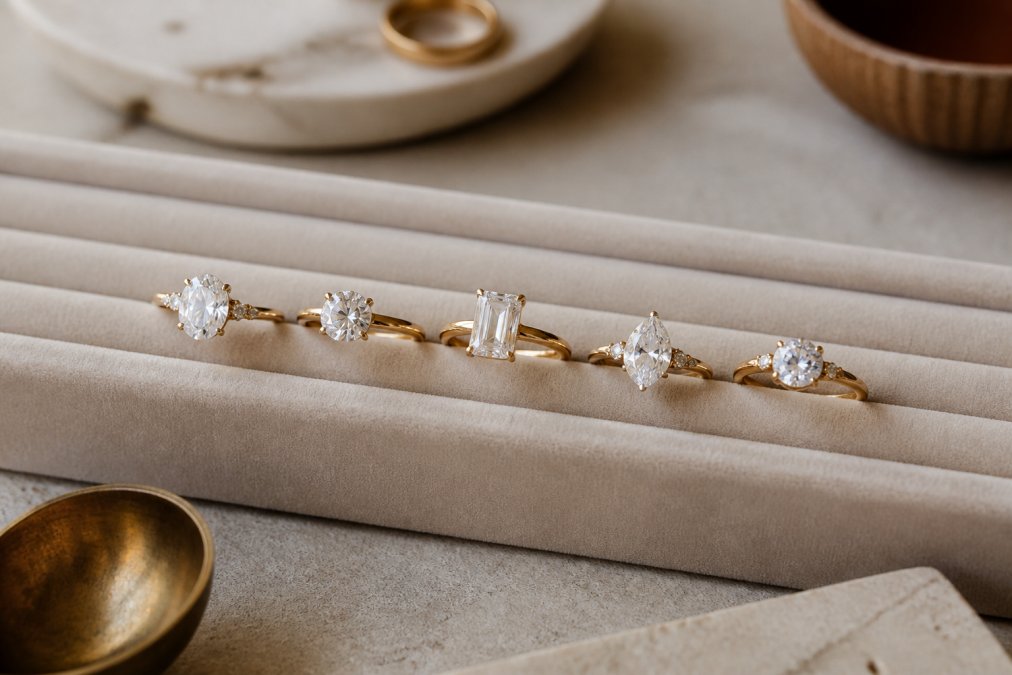
Our curated collection focuses on solitaire settings. Each ring features a lab-grown diamond that is IGI-certified, D color, VS1 clarity, and an Excellent cut grade.
| Ring Style | Carat Weight | Setting | Price |
|---|---|---|---|
| Oval Solitaire | 2ct | Prong | $2,100 |
| Emerald Cut | 1.5ct | Prong | $1,600 |
| Pear / Marquise | 1.5ct - 2ct | Prong | $1,900 - $2,100 |
| Radiant Cut | 2ct | Prong Solitaire | $2,000 |
| Cushion with Pavé | 1.5ct + .5ct pave | Prong | $2,200 |
1. Oval Solitaire: The Timeless Choice for Maximum Sparkle
The oval cut is one of the most requested shapes for its ability to elongate the finger and deliver exceptional fire.

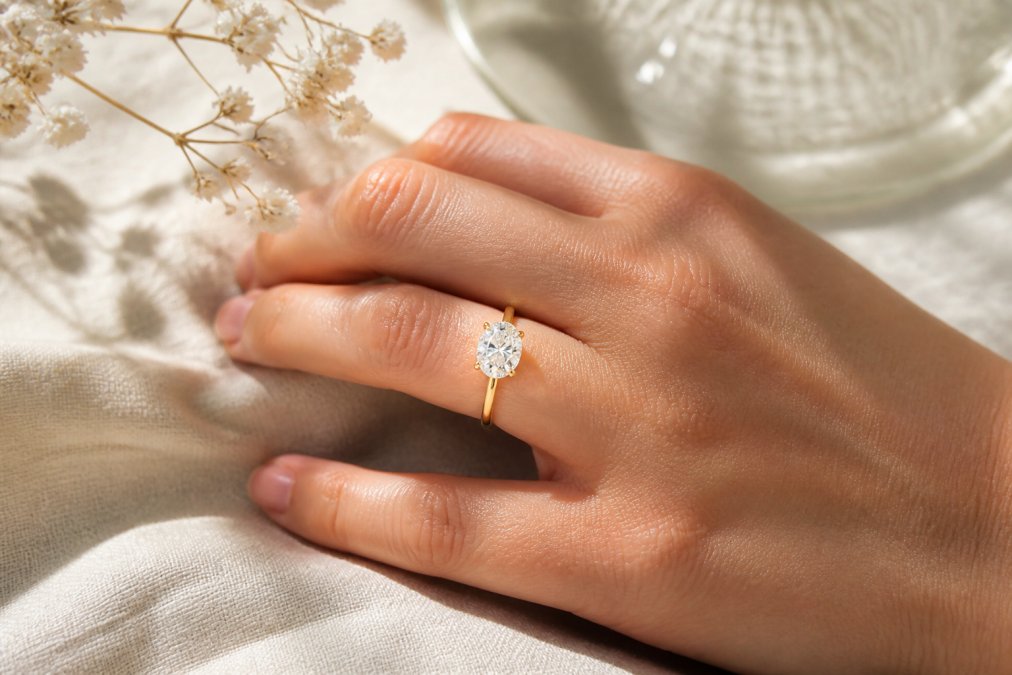
The Oval Lab Grown Diamond Engagement Ring | 2ct IGI Certified | 14K Yellow Gold Solitaire at $2,100 offers a 2-carat center stone in a four-prong setting that allows maximum light to enter. A 1.5ct version is available for $1,900 with the same D grade and VS1 clarity.
2. Emerald Cut: A Sophisticated Step Toward Vintage Glamour
Unlike brilliant cuts, the emerald cut features step facets that create a hall-of-mirrors effect, emphasizing clarity and the stone's pure, open table.
The Elongated Emerald Cut Lab Grown Diamond Engagement Ring | 1.5ct IGI Certified | 14K Yellow Gold is our most accessible entry point at $1,600. The elongated shape adds a modern twist to a vintage-inspired silhouette, and the high VS1 clarity is particularly important as step cuts reveal inclusions more readily than brilliant cuts.
3. Pear and Marquise Cuts: Elongated Silhouettes for a Unique Look
The pear and marquise cuts offer dramatic, elongated silhouettes that maximize perceived carat weight.
The Pear Lab Grown Diamond Engagement Ring | 1.5ct IGI Certified | 14K Yellow Gold and the Marquise Lab Grown Diamond Engagement Ring | 1.5ct IGI Certified | 14K Yellow Gold Solitaire are both priced at $1,900. The pear combines the brilliance of a round with the point of a marquise, while the marquise creates a regal, elongated look. Both feature a prong setting that protects the pointed tips, the most vulnerable part of these cuts.

4. Radiant Cut: The Best of Both Brilliance and Fire
The radiant cut resolves the dilemma between emerald's clean lines and round's sparkle.
The Radiant Cut Lab Grown Diamond Engagement Ring | 2ct IGI Certified | 14K Yellow Gold Solitaire at $2,000 is a standout for its pure, unadorned solitaire design, letting the 2-carat stone capture and refract light intensely. It is the best choice for maximum sparkle in a modern, architectural shape.
5. Cushion Cut with Pavé: A Touch of Vintage Romance
The cushion cut is a square or rectangular shape with rounded corners and larger facets, creating a soft, romantic sparkle. When set in a pavé band, the entire ring becomes a continuous river of light.
For this look, Native Jewel offers the Cushion Cut Lab Grown Diamond Engagement Ring | 2ct IGI Certified | 14K White Gold at $2,200. Crafted in 14k white gold, the pavé diamonds blend seamlessly with the metal for a sleek, icy look. It features a 1.5-carat cushion center stone complemented by 0.5 carats of pavé diamonds along the band.
14k Gold vs 18k Gold Durability: Why 14k Wins for Everyday Wear
Understanding the metallurgy behind karat ratings is the most valuable knowledge for a budget-conscious shopper.
The Alloy Mechanics: What the Karat Number Actually Means
Pure gold (24k) is too soft for regular impact. Jewelers mix it with alloy metals, typically copper, silver, nickel, and zinc. The karat number tells you the percentage of pure gold by weight:
- 10k gold: 41.7% pure gold (10 parts gold, 14 parts alloy)
- 14k gold: 58.3% pure gold (14 parts gold, 10 parts alloy)
- 18k gold: 75.0% pure gold (18 parts gold, 6 parts alloy)
That difference translates directly to hardness. 14k gold is generally harder than 18k gold, and pure 24k gold is very soft.
Why 10k Matters for Your Budget
10k gold is harder than 14k and generally more scratch-resistant, often costing less per gram.
The trade-off is color and potential skin sensitivity. 10k gold has a lighter yellow tone and a higher concentration of nickel, the most common metal allergen. If you have sensitive skin, 10k is risky. For everyone else, it is a legitimate value play, but 14k remains the sweet spot for most buyers.
The White Gold Complication
If you're considering white gold, the durability calculus changes entirely. White gold is alloyed with white metals like palladium or nickel, then coated with rhodium, a hard, silvery-white metal from the platinum family, which gives it its bright, mirror-like finish.
Rhodium plating wears off, it's not a question of if, but when. For a ring worn daily, re-plating may be needed periodically. This can incur maintenance costs over time.
This is why yellow gold and rose gold have a hidden cost advantage: they require no plating and no periodic maintenance beyond routine cleaning.
Prong Integrity: The Real Safety Issue
The most expensive failure mode for any engagement ring isn't a scratched band, it's a lost diamond. Prongs are the thin metal claws that hold your center stone, and they're the weakest structural point of any ring.
In softer 18k gold, prongs bend more easily and can gradually lift away from the diamond. In 14k gold, prongs hold their position better but are still subject to wear. Inspecting prongs periodically and tightening as needed is recommended.
The Hardness Reality Check
Some may suggest 18k is "fine for everyday wear." However, 14k gold is generally more resistant to scratches than 18k gold.
For an engagement ring worn while typing, cooking, cleaning, and living, 14k gold is the clear winner. It offers good yellow color depth with better durability and a lower price point.
Making the Right Choice for Your Budget
- Choose 10k if: Your budget is extremely tight, you have no metal allergies, and you prioritize maximum scratch resistance over color depth.
- Choose 14k if: You want the best overall balance of color, durability, and value, which is why it's the industry standard for fine jewelry.
- Choose 18k if: You're buying a ring for occasional wear (not daily), you prioritize the deepest yellow color, and you're willing to accept more frequent maintenance and a higher risk of prong damage.
For most engagement ring purchases, 14k is the rational choice.
Can You Wear 14k Gold in the Ocean? What You Need to Know
Yes, you can wear 14k gold in the ocean without ruining the metal, but it is not recommended for the safety of your diamond. Saltwater does not corrode gold, but it can wash away natural skin oils, making the ring feel looser and more likely to slip off.
A greater risk is sand and debris, which can scratch the band and get lodged in prong settings. If a prong is bent or loosened, the center stone could be lost in the surf. The same guidance applies to pools, where chlorine can weaken metal alloys over time. The safest practice is to remove your 14k gold engagement ring before swimming. If it gets exposed, rinse it with fresh water and dry it thoroughly.
The Real Cost Question: Total Cost of Ownership
Considering the total cost of ownership over the life of the ring is important. Here's what you should budget for beyond the initial purchase:
Routine Maintenance: The Annual Baseline
Every engagement ring requires professional care. At minimum, have your ring professionally cleaned and inspected once per year. This service may incur a cost. During this visit, the jeweler will:
- Ultrasonically clean the ring to remove buildup that brushing can't reach
- Inspect each prong under magnification for signs of wear or lifting
- Check the band for thinning or stress fractures
- Tighten any loose prongs
- Polish out minor surface scratches
If you skip these annual checkups, small issues become big ones. A slightly loose prong can become a lost diamond.
The Hidden Cost of White Gold: Rhodium Re-plating
If you chose a white gold ring, you've signed up for an ongoing maintenance expense that yellow gold and rose gold owners never face. White gold is plated with rhodium to achieve its bright white finish, and that plating wears off with daily use. Most people need re-plating every 12-18 months.
The cost of rhodium re-plating can add to the total cost of your ring over time. This is why we recommend yellow gold for budget-conscious buyers.
Prong Re-tipping: The Expense Nobody Mentions
After 5-10 years of daily wear, the prongs holding your center stone will eventually wear thin. When they become too thin to safely hold the stone, they need to be re-tipped: a jeweler adds new metal to rebuild the prong structure.
Prong re-tipping can be an expense. A four-prong setting may eventually need all four prongs re-tipped. This is an unavoidable expense for any ring worn daily, though 14k gold prongs will need re-tipping less frequently than 18k because the harder alloy wears more slowly.
Sizing Adjustments: Plan for the Inevitable
Your finger size will change over time. Weight fluctuations, pregnancy, temperature changes, and aging can shift your ring size by half a size or more over a decade, requiring a resize.
Not all settings can be resized easily. Solitaire settings with a plain band are the most resize-friendly, a jeweler can typically adjust them by 1-2 sizes. However, rings with pavé diamonds along the entire band, eternity bands, or intricate vintage-style settings may not be resizable at all, because cutting and re-soldering the band would damage the small stones.
If your ring can be resized, a cost may be incurred. If it can't, you're facing the cost of a new ring, which is why we recommend choosing a solitaire or a ring with pavé only on the top half of the band for maximum flexibility.
The 10-Year Cost Projection
Here's what a typical 14k yellow gold solitaire ring with a 2-carat lab-grown diamond will cost over 10 years of ownership:
| Cost Item | Year 1 | Years 2-5 (annual) | Years 6-10 (annual) | 10-Year Total |
|---|---|---|---|---|
| Initial ring purchase | $2,100 | , | , | $2,100 |
| Professional cleaning & inspection | $50 | $50 | $50 | $500 |
| Prong re-tipping (once, year 7) | , | , | $200 | $200 |
| Ring resizing (once, year 3) | , | $100 | , | $100 |
| Total | $2,150 | $200 | $450 | $2,900 |
A white gold version of the same ring adds $75 per year for rhodium re-plating, bringing the 10-year total to $3,650, a 26% increase over yellow gold.
How to Protect Your Investment
A few simple habits can dramatically extend the life of your ring and reduce long-term costs:
- Remove your ring during high-impact activities: Gardening, weightlifting, moving furniture, and any activity where your hands might strike hard surfaces.
- Take it off before swimming: As discussed above, the risk isn't the water, it's the sand, chlorine, and the increased chance of the ring slipping off.
- Store it properly: When not wearing your ring, keep it in a dedicated jewelry box or pouch. Don't toss it loose in a drawer where it can scratch against other jewelry.
- Clean it weekly: A 5-minute soak in warm water with mild dish soap, followed by a gentle brush with a soft toothbrush, removes the oils and lotions that dull both the gold and the diamond.
- Insure it: Jewelry insurance can provide protection against loss, theft, or damage.
Regular cleaning helps maintain the sparkle of your 14k gold engagement ring. A simple solution of warm water and mild dish soap, applied with a soft-bristled brush, removes the daily buildup of lotion and oils that can dull the diamond's brilliance. For a deeper clean, professional services can check the integrity of the prongs and ensure your setting remains secure.
Frequently Asked Questions
Is 14k gold durable enough for daily wear in an engagement ring?
Yes, 14k gold is an excellent choice for daily wear. Its 58.3% gold content is alloyed with stronger metals like copper and silver, making it significantly more scratch-resistant and durable than 18k gold. Unlike higher-karat golds, 14k holds up well against the bumps and knocks of everyday life, making it a practical and lasting choice for an engagement ring you will wear every day.
What is the difference between 14k and 18k gold for engagement rings?
The main difference is gold purity. 18k gold contains 75% gold, while 14k gold has 58.3%. This makes 18k gold softer, more prone to scratches, and more expensive. While 18k has a richer yellow hue, 14k gold offers superior durability for daily wear, making it a smarter, more affordable investment for an engagement ring that will last.
Are lab-grown diamonds a good way to save money on gold engagement rings?
Lab-grown diamonds are an excellent way to maximize your budget. They are chemically, physically, and optically identical to natural diamonds. By choosing a lab-grown diamond, you can afford a higher carat weight or a better clarity grade within your budget, allowing you to invest in the quality of the 14k gold setting as well.
How can I verify the authenticity of 14k gold jewelry?
Authentic 14k gold jewelry should have a hallmark stamp, usually reading '14k' or '585', indicating the gold purity. For diamonds, look for a certification from an independent gemological laboratory like IGI. A certificate from IGI guarantees the diamond's carat weight, color, clarity, and cut, providing proof of quality and value for your purchase.
Can you wear 14k gold rings in the ocean or pool?
While 14k gold itself won't dissolve or rust in the ocean, it's best to avoid wearing your ring in saltwater or chlorinated pools. These environments can dull the gold's shine and may weaken the metal over time. More importantly, your diamond could be knocked loose from its setting. Always remove your ring before swimming to keep it safe and sparkling.