 blog
blog
14K Gold vs 18K Gold Durability: Which Lasts Longer?
Table of Contents
- Understanding Gold Karat and Purity
- 14K Gold vs 18K Gold: Durability and Scratch Resistance
- 14K Gold vs 18K Gold Price Difference and Value
- Is 14K Gold Good for Engagement Rings?
- Tarnish, Discoloration, and Color Saturation
- How to Care for 14K Gold Jewelry
- Maintenance and Repairability
- Conclusion
- Frequently Asked Questions
Last Updated: September 4, 2026
Understanding Gold Karat and Purity
Gold karat measures the proportion of pure gold in an alloy, expressed as parts out of 24. Pure gold is 24 karat, meaning 24 out of 24 parts are gold. 14k gold contains 58.3% gold mixed with 41.7% other metals, while 18k gold contains 75% gold and 25% alloy metals.
Copper, silver, nickel, and zinc are added to increase hardness and alter color, since pure gold is naturally soft and malleable.
14K Gold vs 18K Gold: Durability and Scratch Resistance
14k gold is significantly more durable than 18k gold because its higher alloy content makes it harder and more resistant to bending and scratching. The tradeoff is that 18k gold offers a richer, more saturated yellow color due to its higher gold content.
Alloy Composition and Tensile Strength
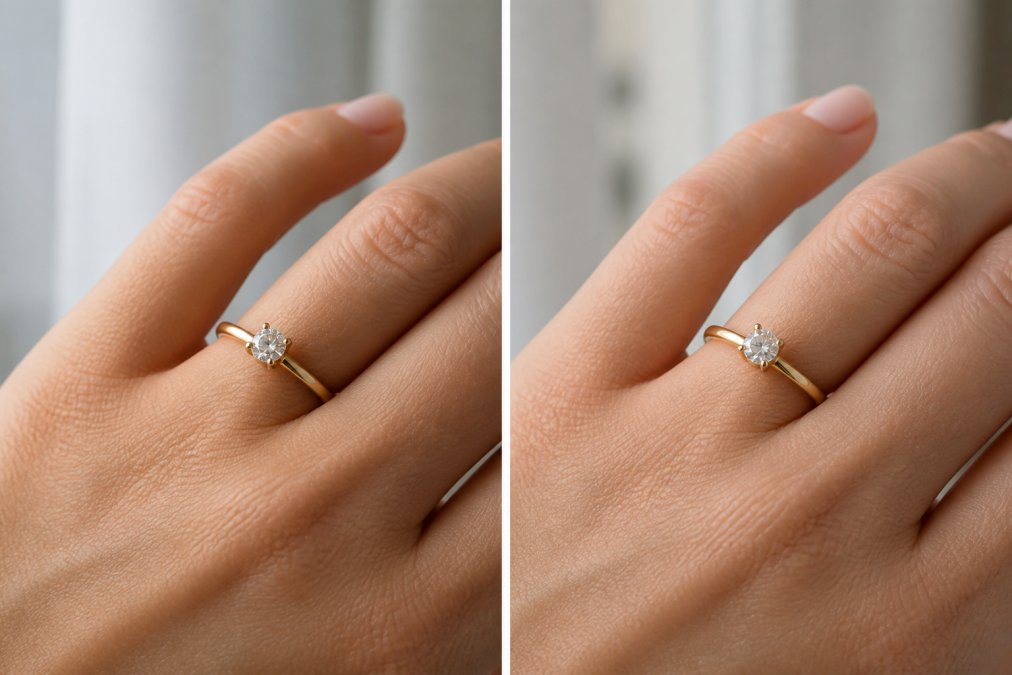
The difference in tensile strength comes down to the metals added during alloying. With 41.7% harder metals like copper and silver, 14k gold forms a stronger internal structure than 18k gold, which contains only 25% alloying metals.
In practice, this means a 14k gold band will resist warping better than an 18k band of the same thickness. For rings that hold a center stone, this structural integrity matters. A softer shank can gradually bend over years of wear, potentially loosening the prongs that secure your diamond.
Hardness and Daily Wear Performance
On common hardness scales, 14k gold scores higher than 18k gold, making it the better choice for rings worn every day. The higher hardness translates to fewer visible scratches and less metal loss over time.
For engagement rings specifically, the durability of 14k gold is a meaningful advantage. Your ring endures constant contact with door frames, keyboards, gym equipment, and countless other surfaces. While both metals will show some wear eventually, 14k gold holds its finish noticeably better under these conditions.
14K Gold vs 18K Gold Price Difference and Value
18k gold's higher gold content (75% vs. 58.3%) commands a higher price per gram. 14k gold delivers better value: a harder, more practical metal at lower cost, freeing up budget for a larger or higher-quality center stone.
| Comparison Factor | 14K Gold | 18K Gold |
|---|---|---|
| Pure Gold Content | 58.3% | 75% |
| Relative Hardness | Higher | Lower |
| Scratch Resistance | Better | Moderate |
| Color Saturation | Lighter yellow | Richer yellow |
| Best Suited For | Daily wear rings | Fine pendants, earrings |
Is 14K Gold Good for Engagement Rings?
Yes, 14k gold is an excellent choice for engagement rings. The superior hardness protects both the band and the stone setting over decades of daily wear. A common mistake is assuming higher gold content means better quality; for engagement rings, the opposite is often true.
If you cook, clean, exercise, or garden with your ring on, 14k gold will maintain its shape and finish far better than 18k. The lower gold content also means a more affordable ring, allowing you to invest more in the diamond itself.
Tarnish, Discoloration, and Color Saturation
The alloy composition, not just karat weight, determines how each metal behaves over decades. Understanding these differences by color type is essential for predicting long-term durability.
Yellow Gold: Copper Content and Darkening
14k yellow gold contains 20-25% copper versus 15-20% in 18k. Higher copper content makes 14k harder but more prone to subtle darkening over 10-15 years of daily wear, especially in humid climates or with frequent exposure to lotions and perfumes. This oxidation is easily reversed with professional polishing.
18k yellow gold displays a deep, warm honey tone due to 75% pure gold content, while 14k appears noticeably paler, a trade-off many active wearers accept for superior scratch resistance.
White Gold: Rhodium Plating and Nickel Sensitivity
Both 14k and 18k white gold are rhodium-plated at manufacture for a bright, silvery finish. The underlying alloy, gold mixed with nickel, palladium, or both, determines how long the plating lasts.
14k white gold typically contains 40-45% nickel or palladium, making it harder with rhodium plating that lasts 18-24 months longer than 18k. However, nickel-based 14k white gold carries higher skin sensitivity risk; if you have sensitive skin, specify palladium-based 14k white gold.
18k white gold contains 25% alloy metals, often palladium-gold. Its rhodium plating requires re-plating every 12-18 months with daily wear, but the underlying metal is naturally hypoallergenic. Once plating wears through, it reveals a warmer, champagne-toned surface.
Rose Gold: Copper Stability and Color Consistency
Rose gold maintains its warm pink tone indefinitely in both 14k and 18k because copper does not significantly oxidize under normal wear conditions, making it ideal for heirloom pieces.
How to Care for 14K Gold Jewelry
Clean 14k gold jewelry every few weeks with warm water, mild dish soap, and a soft-bristled brush. Remove it when swimming in chlorinated pools or applying harsh chemicals, as chlorine weakens gold alloys and lotions dull diamonds. Store pieces separately in soft pouches to prevent scratching. For deeper cleaning, jewelers offer professional ultrasonic cleaning.
Maintenance and Repairability
14k gold is easier and more affordable to repair than 18k gold because its higher hardness allows jewelers to work more confidently and repairs hold longer.
Prong Tightening and Stone Security
Prong tightening, typically needed every 3-5 years, costs depend on the jeweler. 14k gold's higher hardness means prongs resist over-bending and maintain grip reliably. 18k gold's softer structure risks micro-fractures during tightening; if an 18k prong cracks, rebuilding costs depend on the jeweler. 14k prongs rarely crack, making repairs more predictable and potentially less expensive over the ring's lifetime.
Resizing and Band Reinforcement
14k gold resizes cleanly with strong solder joints. 18k gold resizing risks gradual weakening with repeated resizing because each solder cycle removes material. A 14k ring can be resized multiple times over a century with minimal degradation; an 18k ring resized more than twice may develop weak points.
Shank Reinforcement and Structural Repair
After 10-15 years, rings may develop thin spots requiring reinforcement. On 14k gold, adding 14k solder blends seamlessly and holds indefinitely. On 18k gold, adding 14k solder creates a hardness mismatch risking separation; jewelers must use 18k solder, which may still not be as durable as the original metal.
Professional Cleaning and Inspection
Professional ultrasonic cleaning every 12-18 months is available from jewelers and removes soap residue and lotion buildup. Have a jeweler inspect your setting annually for loose prongs, worn solder joints, or thin spots. 14k gold's durability means fewer surprises; 18k gold may reveal wear patterns requiring preventive reinforcement.
Long-Term Cost of Ownership
Over 30 years of daily wear, a 14k gold ring may incur maintenance costs that are generally lower than a comparable 18k gold ring due to higher repair costs and complication risks associated with 18k gold.
Conclusion
For engagement rings and daily-wear jewelry, 14k gold offers superior scratch resistance, structural integrity, and lower maintenance costs. For occasional pieces, 18k gold's richer color may justify the softer metal. The durability evidence is clear: 14k is the practical choice for jewelry worn daily. At Native Jewel, every ring is handcrafted in 14k gold with IGI-certified lab-grown diamonds, backed by a lifetime warranty. Browse our engagement ring collection to find a durable design built for a lifetime of daily wear.
Frequently Asked Questions
Does 14K gold last longer than 18K gold for daily wear?
14K gold is actually more durable for daily wear because it contains more alloy metals that increase hardness and scratch resistance. 18K gold has higher purity (75% vs 58.3% gold content) but is softer due to less alloy reinforcement. For engagement rings and everyday jewelry, 14K gold's superior hardness makes it the more practical choice for long-term durability, though both karat weights can last a lifetime with proper care.
What is the main difference between 14K and 18K gold durability?
The durability difference stems from metal composition. 14K gold contains about 58.3% pure gold mixed with stronger alloys like copper, silver, and nickel, creating a harder metal. 18K gold contains 75% pure gold with fewer alloys, making it softer and more prone to scratching and bending. While 18K offers greater purity and richer color saturation, 14K's increased hardness provides superior scratch resistance and wear resistance for pieces subject to daily contact and activity.
Is 14K gold good for engagement rings compared to 18K?
14K gold is excellent for engagement rings because it balances durability with affordability. Its superior hardness protects the stone setting from wear and resizing damage better than 18K. 14K also costs less, allowing you to invest more in a higher-quality diamond or lab-grown stone. The trade-off is slightly less color saturation compared to 18K, but 14K yellow gold, white gold, and rose gold all retain beautiful color while offering the hardness needed for daily wear jewelry.
How does the gold content affect the scratch resistance of jewelry?
Higher gold content means softer metal. 18K gold's 75% purity makes it more susceptible to scratches and dents because pure gold is a soft metal. 14K gold's 58.3% gold content leaves room for stronger alloy metals that significantly increase hardness on the Vickers hardness scale. This means 14K gold resists scratching better during daily activities, though both require regular maintenance. Rhodium plating on white gold can temporarily improve scratch resistance but wears away over time and requires replating.
Get started with Native Jewel and find a 14k gold ring that pairs lasting durability with timeless elegance.
This article was written using GrandRanker
Frequently Asked Questions
Q: Does 14K gold last longer than 18K gold for daily wear?
A: 14K gold is actually more durable for daily wear because it contains more alloy metals that increase hardness and scratch resistance. 18K gold has higher purity (75% vs 58.3% gold content) but is softer due to less alloy reinforcement. For engagement rings and everyday jewelry, 14K gold's superior hardness makes it the more practical choice for long-term durability, though both karat weights can last a lifetime with proper care.
Q: What is the main difference between 14K and 18K gold durability?
A: The durability difference stems from metal composition. 14K gold contains about 58.3% pure gold mixed with stronger alloys like copper, silver, and nickel, creating a harder metal. 18K gold contains 75% pure gold with fewer alloys, making it softer and more prone to scratching and bending. While 18K offers greater purity and richer color saturation, 14K's increased hardness provides superior scratch resistance and wear resistance for pieces subject to daily contact and activity.
Q: Is 14K gold good for engagement rings compared to 18K?
A: 14K gold is excellent for engagement rings because it balances durability with affordability. Its superior hardness protects the stone setting from wear and resizing damage better than 18K. 14K also costs less, allowing you to invest more in a higher-quality diamond or lab-grown stone. The trade-off is slightly less color saturation compared to 18K, but 14K yellow gold, white gold, and rose gold all retain beautiful color while offering the hardness needed for daily wear jewelry.
Q: How does the gold content affect the scratch resistance of jewelry?
A: Higher gold content means softer metal. 18K gold's 75% purity makes it more susceptible to scratches and dents because pure gold is a soft metal. 14K gold's 58.3% gold content leaves room for stronger alloy metals that significantly increase hardness on the Vickers hardness scale. This means 14K gold resists scratching better during daily activities, though both require regular maintenance. Rhodium plating on white gold can temporarily improve scratch resistance but wears away over time and requires replating.